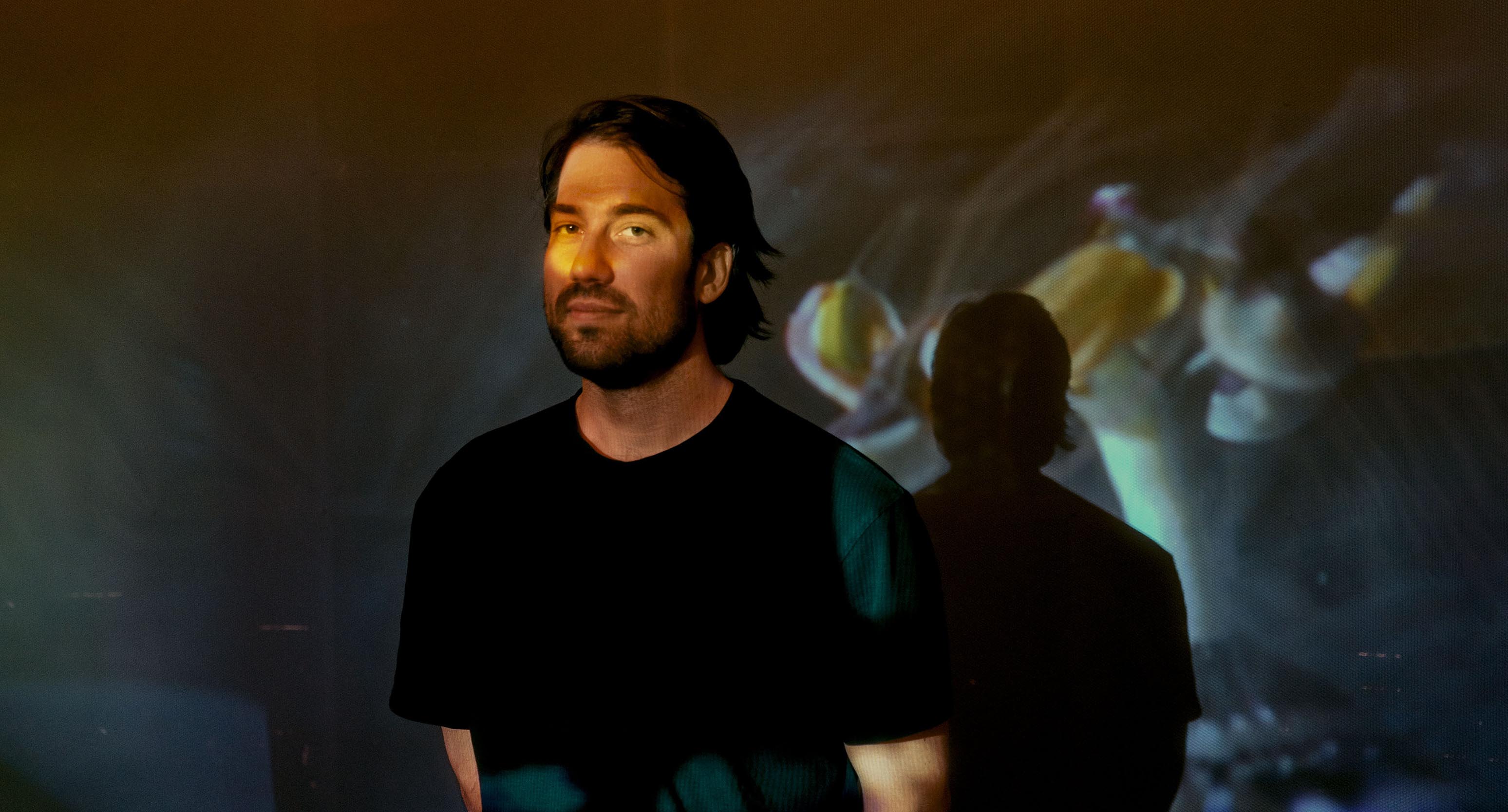
Vincent Rang (1989) is a Dutch visual artist based in Amsterdam, working with video,
installation, and generative systems.
His practice investigates movement, growth, and transformation through time-based visual processes that combine digital techniques with chemical and physical experimentation. His works often take the form of evolving visual environments, liquid paintings, algorithmic structures, and filmed micro-transformations, where images shift, deform, and reorganize over time.
Having grown up across five countries, Rang’s work reflects a sensitivity to instability, transition, and changing contexts. Rather than treating images as fixed outcomes, he is interested in how visual forms behave over time, how they drift, accumulate, or break down in response to internal and external forces. His practice often explores the balance between control and surrender, setting conditions for processes to unfold while allowing material behavior, chance, and duration to shape the final image. Technology, in this context, is approached less as a tool for control and more as a system that can host transformation, uncertainty, and gradual change.
In recent years, Rang has developed projects that explore expanded temporal perception through material and computational processes. In Monolith (2022), he combined installation and performance to evoke deep geological time through iron salt reactions unfolding inside an aquarium filled with sodium silicate. In Arbor (2023), developed in collaboration with NAP Labs, he created generative software that simulates slow growth processes, inviting reflection on extended time scales and organic development.
His work also includes collaborative audiovisual performances such as Home, created with Boris Acket, which was performed at the Muziekgebouw and Nxt Museum, as well as Monolith, developed together with pianist Helena Basilova and sound artist Kenny Kneefel. Rang has exhibited and presented work at festivals and venues including Dark Rooms Berlin, Fiber Festival, INOTA Festival, Amsterdam Dance Event, International Film Festival Rotterdam, and Schemerlicht Festival. He has received grants from the Stimuleringsfonds and the Amsterdam Fund for the Arts.
His recent research focuses on site-responsive and durational works in which image, material, and environment interact, allowing temporal change itself to become a central compositional element.
His practice investigates movement, growth, and transformation through time-based visual processes that combine digital techniques with chemical and physical experimentation. His works often take the form of evolving visual environments, liquid paintings, algorithmic structures, and filmed micro-transformations, where images shift, deform, and reorganize over time.
Having grown up across five countries, Rang’s work reflects a sensitivity to instability, transition, and changing contexts. Rather than treating images as fixed outcomes, he is interested in how visual forms behave over time, how they drift, accumulate, or break down in response to internal and external forces. His practice often explores the balance between control and surrender, setting conditions for processes to unfold while allowing material behavior, chance, and duration to shape the final image. Technology, in this context, is approached less as a tool for control and more as a system that can host transformation, uncertainty, and gradual change.
In recent years, Rang has developed projects that explore expanded temporal perception through material and computational processes. In Monolith (2022), he combined installation and performance to evoke deep geological time through iron salt reactions unfolding inside an aquarium filled with sodium silicate. In Arbor (2023), developed in collaboration with NAP Labs, he created generative software that simulates slow growth processes, inviting reflection on extended time scales and organic development.
His work also includes collaborative audiovisual performances such as Home, created with Boris Acket, which was performed at the Muziekgebouw and Nxt Museum, as well as Monolith, developed together with pianist Helena Basilova and sound artist Kenny Kneefel. Rang has exhibited and presented work at festivals and venues including Dark Rooms Berlin, Fiber Festival, INOTA Festival, Amsterdam Dance Event, International Film Festival Rotterdam, and Schemerlicht Festival. He has received grants from the Stimuleringsfonds and the Amsterdam Fund for the Arts.
His recent research focuses on site-responsive and durational works in which image, material, and environment interact, allowing temporal change itself to become a central compositional element.