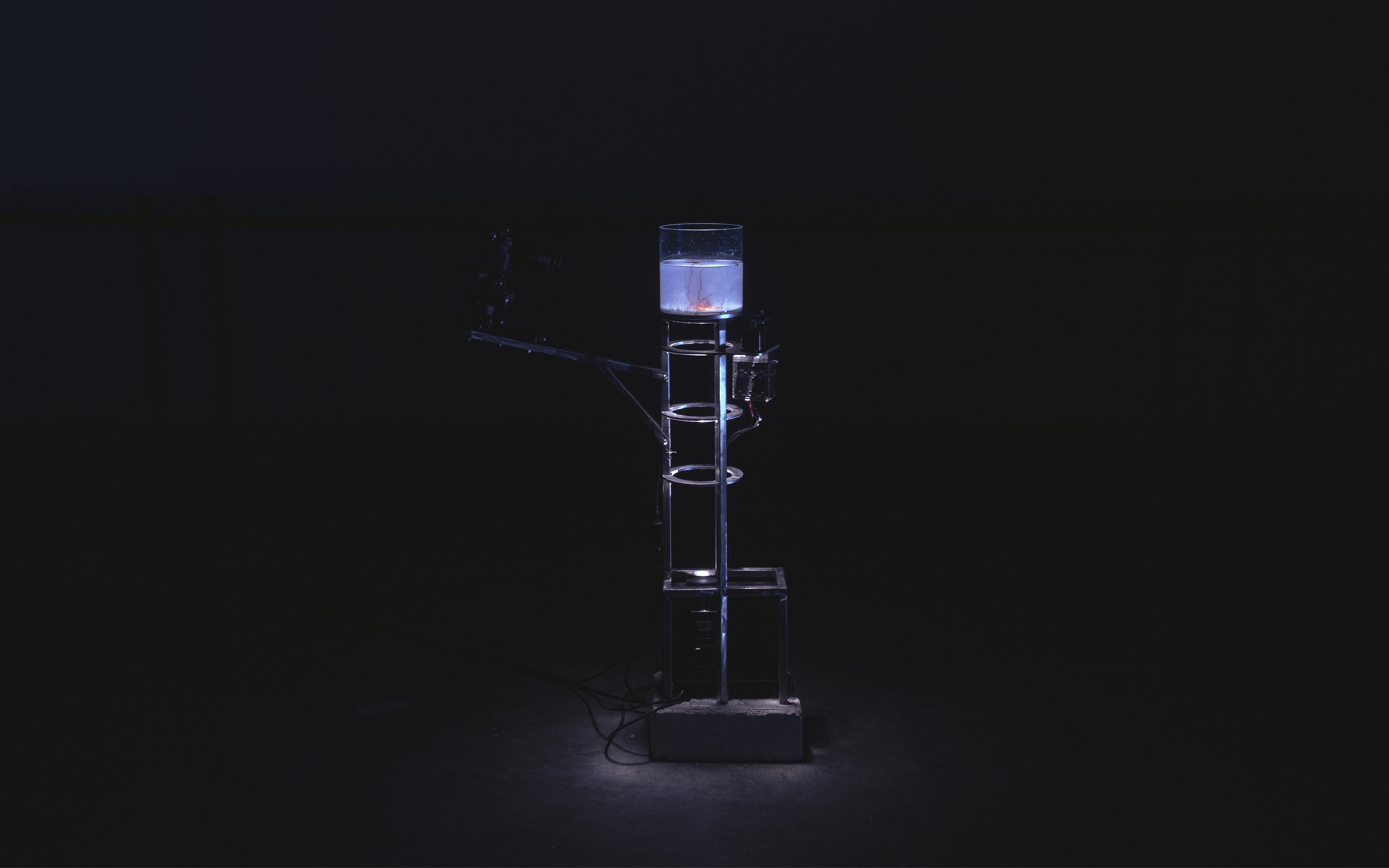
Monolith (2022-ongoing)
Live chemical installation using sodium silicate reactions, projected light, a rotating aquarium, live macro video, and large-scale projection.
Monolith is a process-based installation that explores chemical growth systems inspired by early experiments in synthetic biology. Inside a glass aquarium filled with sodium silicate, iron salts react to form branching mineral structures known as chemical gardens, producing organic forms that appear to grow and evolve over time.
These reactions are filmed live using a macro camera and projected onto a large screen, transforming microscopic chemical activity into monumental
visual landscapes. The installation reveals a world of slowly morphing structures that resemble biological organisms while emerging entirely from inorganic matter.
Inspired by the research of French physician Stéphane Leduc, Monolith questions the boundary between living and non-living systems. By presenting chemical self-organization as a generative visual process, the work invites reflection on how life- like behaviour can emerge from purely physical conditions.
Credits
Concept and visual system
Vincent Rang
Technical Engineering
Jord Beets
Music Composition
Helena Basilova Kenny Kneefel (Shoal)
Additional Software
Emanuel Nijkerk
Supported by
Amsterdam Fund for the Arts (AFK)
Monolith is a process-based installation that explores chemical growth systems inspired by early experiments in synthetic biology. Inside a glass aquarium filled with sodium silicate, iron salts react to form branching mineral structures known as chemical gardens, producing organic forms that appear to grow and evolve over time.
These reactions are filmed live using a macro camera and projected onto a large screen, transforming microscopic chemical activity into monumental
visual landscapes. The installation reveals a world of slowly morphing structures that resemble biological organisms while emerging entirely from inorganic matter.
Inspired by the research of French physician Stéphane Leduc, Monolith questions the boundary between living and non-living systems. By presenting chemical self-organization as a generative visual process, the work invites reflection on how life- like behaviour can emerge from purely physical conditions.
Credits
Concept and visual system
Vincent Rang
Technical Engineering
Jord Beets
Music Composition
Helena Basilova Kenny Kneefel (Shoal)
Additional Software
Emanuel Nijkerk
Supported by
Amsterdam Fund for the Arts (AFK)